Did you know that a magnetic compass doesn’t actually point to true north?
This page explains how a magnetic compass works, why it is rarely accurate, and how to compensate for its shortcomings to get a true bearing that can be reliably used for safe navigation. The Bermuda pilots license exam will contain many questions on the magnetic compass, all of which can be answered by studying the info on this page.
1. Compass Points
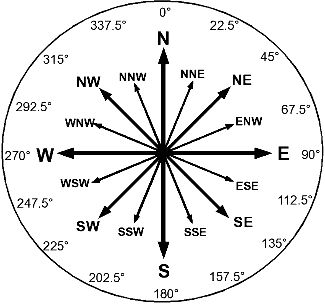
A compass is divided into 360 degrees (°), forming a complete circle. Bearings are always measured clockwise from North (000° or 360°).
The four cardinal directions are:
- North (N) = 000°/360°
- East (E) = 090°
- South (S) = 180°
- West (W) = 270°
Halfway between these there are another 4 intercardinal directions:
- NE = 045°
- SE = 135°
- SW = 225°
- NW = 315°
And in between the cardinal and intercardinal directions we can add a further 8 points to complete the 16-point compass as per the image above:
- NNE = 022.5°
- ENE = 067.5°
- ESE = 112.5°
- SSE = 157.5°
- SSW = 202.5°
- WSW = 247.5°
- WNW = 292.5°
- NNW = 337.5°
We can keep dividing the spaces even more, but for the Bermuda pilots license exam the 16 points above are enough.
2. Types of North
Understanding the 3 different types of “North” is essential for safe navigation. They are True, Magnetic, and Compass.
True North (T)
- True North is the direction of the Earth’s geographic North Pole, right at the top center of the earth.
- It is what is shown on charts and maps.
Compass North (T)
- Compass North is the direction the North needle on compass points.
- Since the compass needle is a simple floating magnet, it can be affected by nearby magnetic forces such as electromagnetic waves that are emitted from most electronics and other wires carrying electricity.
- Compass north is affected by both Variation and Deviation, as described in detail below.
Magnetic North (M)
- Magnetic North is the direction a compass points, toward the Earth’s magnetic field, assuming it has no other interference (e.g. nearby electronics).
- Magnetic North is generally close to, but not located at, the geographic North Pole.
- Magnetic north moves because Earth’s magnetic field is generated by the churning, swirling ocean of liquid iron in our planet’s outer core. As these molten metals shift and flow, they change the underlying magnetic fields, causing the magnetic north pole to continually wander across the Arctic.
- A compass indicates Magnetic North unless it is affected by nearby magnetic influences (which happens on most boats and further misaligns the compass! see Deviation section below)
3. Variation (Magnetic Variation)
Variation is the angle between True North and Magnetic North.
- It is caused by the Earth’s magnetic field.
- It depends on your location!
- It is printed on nautical charts, specific to the area in the chart, and changes slightly each year.
- In 1985, the magnetic declination (variation) in Bermuda was approximately 15.5° West. Today, the magnetic declination in Hamilton, Bermuda, stands at 14.39° West (14°23′). So in the last 40 years magnetic north has shifted by more than 1 degree!
Remember:
- East variation: Magnetic North lies east of True North.
- West variation: Magnetic North lies west of True North.
Example:
- Variation = 15° East
- A True bearing of 0°T (heading due north) becomes 115°M (on the compass). So if you want to head true north on your boat, you would steer at 15° on the compass!
4. Deviation
Deviation is the error caused by magnetic influences on the vessel itself.
Sources include:
- Engines
- Batteries
- Electronics
- Steel structures
- Speakers and magnets
Deviation:
- Changes with the vessel’s heading.
- Is determined by swinging the compass.
- Is recorded on a Deviation Card kept near the compass.
Example:
| Compass Heading | Deviation |
|---|---|
| 000° | 1°E |
| 090° | 3°W |
| 180° | 2°E |
| 270° | 1°W |
Unlike variation, deviation is unique to each vessel.
4. Relationship Between the Three Bearings
The sequence is:
True → Magnetic → Compass
- Variation converts between True and Magnetic.
- Deviation converts between Magnetic and Compass.
5. Converting True to Magnetic
Use the chart’s variation.
Rule
- East Variation: Add
- West Variation: Subtract
Example 1
True bearing = 065°T
Variation = 7°E
Magnetic bearing = 065 + 7 = 072°M
Example 2
True bearing = 250°T
Variation = 5°W
Magnetic bearing = 250 − 5 = 245°M
6. Converting Magnetic to True
Reverse the process.
Rule
- East Variation: Subtract
- West Variation: Add
Example 1
Magnetic bearing = 140°M
Variation = 6°E
True bearing = 140 − 6 = 134°T
Example 2
Magnetic bearing = 310°M
Variation = 4°W
True bearing = 310 + 4 = 314°T
7. Including Deviation
When using the vessel’s compass, you may also need to account for deviation.
Compass to True
- Correct for deviation.
- Correct for variation.
True to Compass
- Correct for variation.
- Correct for deviation.
8. Memory Aids
A common mnemonic is:
“Add East, Subtract West” when converting True → Magnetic.
Reverse it for Magnetic → True:
“Subtract East, Add West.”
Another helpful sequence is:
True → Variation → Magnetic → Deviation → Compass
Working backwards:
Compass → Deviation → Magnetic → Variation → True
9. Exam Tips
- True bearings are measured from True North.
- A magnetic compass points toward Magnetic North.
- Variation comes from the Earth’s magnetic field and is shown on charts.
- Deviation comes from the boat and is listed on the deviation card.
- Variation depends on location.
- Deviation depends on the vessel and its heading.
- Always check whether variation is East or West before applying corrections.
- If a calculation gives more than 360°, subtract 360°.
- If a calculation is negative, add 360°.
Quick Reference
| Conversion | East | West |
| True → Magnetic | Add | Subtract |
| Magnetic → True | Subtract | Add |
| Magnetic → Compass | Add East Deviation / Subtract West Deviation | |
| Compass → Magnetic | Subtract East Deviation / Add West Deviation |